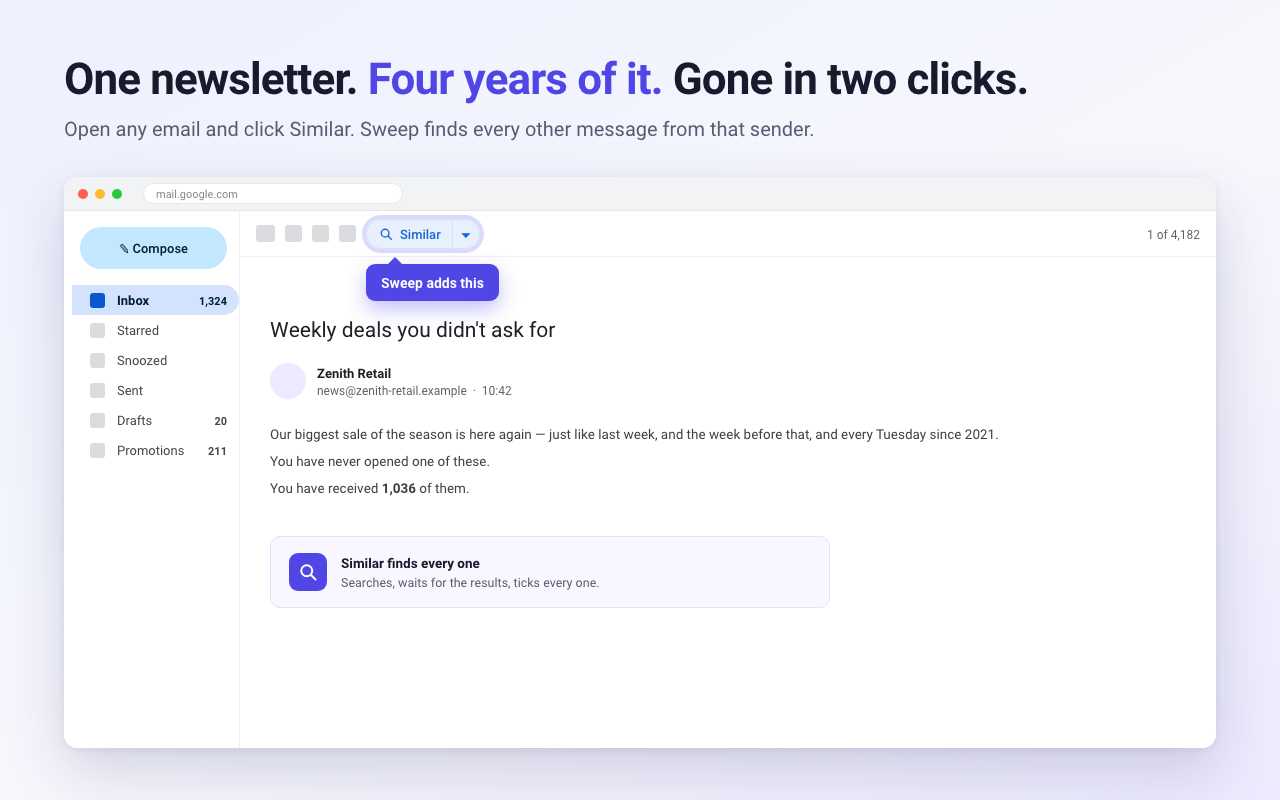
A newsletter you signed up for once and stopped reading — every message from it, gone. Sweep finds them all and selects the lot, then you press Delete. It never signs in to anything and makes no network requests, so your mail stays exactly where it is.
Three steps, and the last one is Gmail's.
Any message from the sender you're tired of. Sweep reads who sent it.
Sweep searches your mail, waits for the results, and ticks every match — all of them, not just the ones on screen.
Gmail's own button. Everything goes to Trash, recoverable for 30 days.
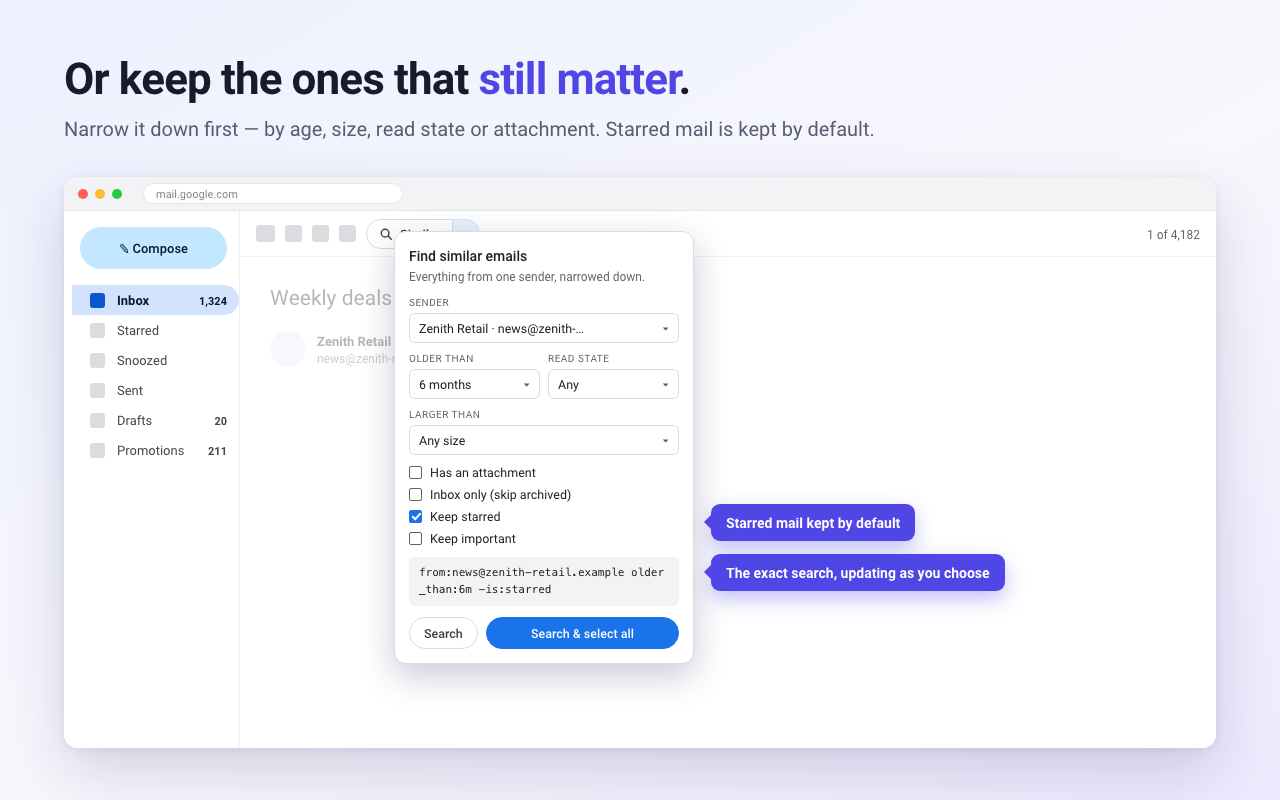
Not everything from a sender is junk. Open the panel and keep what still matters.
7 days, 1 month, 6 months, 1 year or 2 years. Keep the recent ones.
1, 5, 10 or 25 MB. Reclaim storage first, worry about the rest later.
Delete what you've already seen. Or only what you never opened.
On by default. Important mail can be protected too.
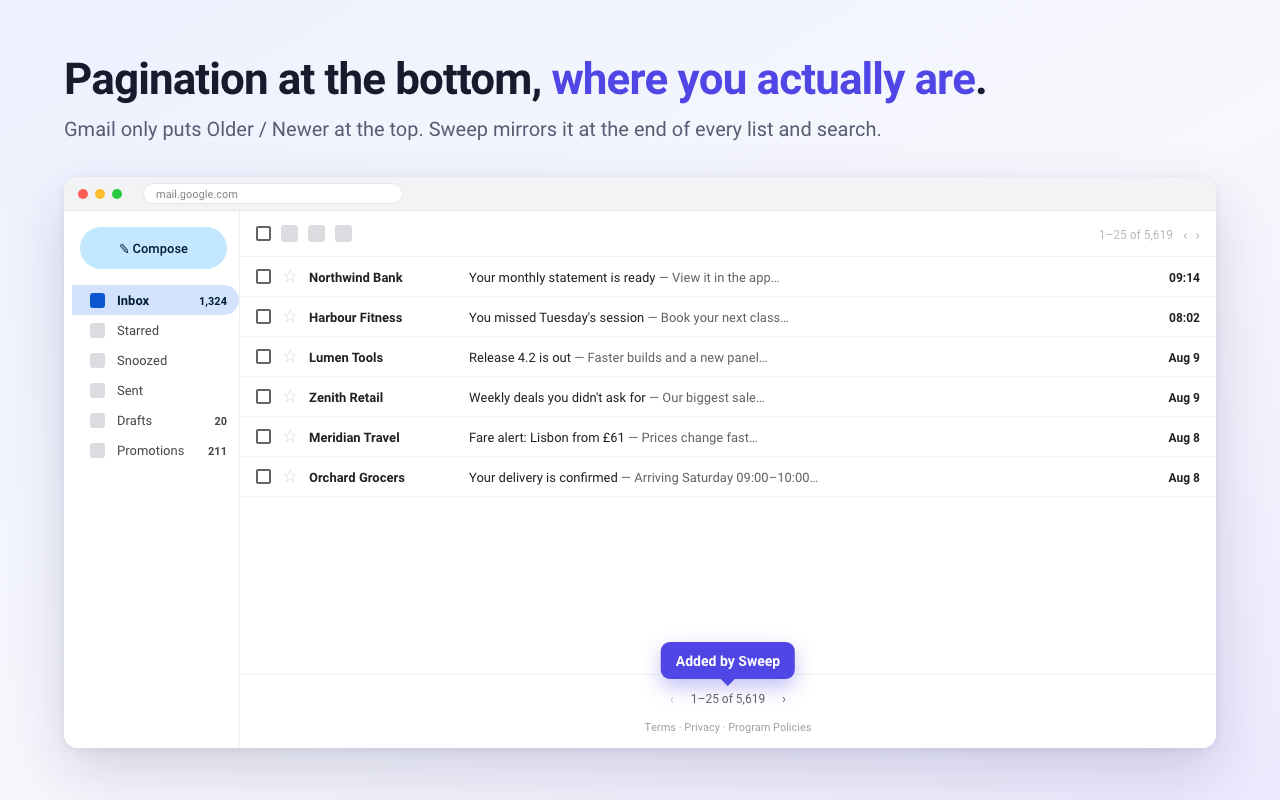
Gmail puts Older / Newer at the top of the list and nowhere else, so every page turn means scrolling back up. Sweep mirrors it at the end of every list and every search.
Not "does not" — cannot. Sweep has no server and never asks for your Google account, so there is nowhere for your mail to go and nothing to connect to.
| Sweep | Typical inbox cleaner | |
|---|---|---|
| Sign in with Google | Never asked | Required |
| Grants mailbox access to a server | No server exists | Yes |
| Reads mail when your browser is closed | Impossible | Usually |
| Network requests | None at all | Continuous |
| Source code | Public | Closed |
It does say that, and it is worth understanding rather than ignoring. Chrome shows that line for every extension that touches a web page — an ad blocker, a grammar checker, a dark-mode theme. It describes the page in front of you, not your account.
For Sweep it means: while a Gmail tab is open, it can see that tab and click things
in it, exactly as you can. That is the whole mechanism — it finds the sender and
ticks the checkboxes so you don't have to. It is limited to
mail.google.com and to the moments you have Gmail open.
What that permission does not grant, and what the code cannot do: reach your mail when the browser is closed, sign in to your account, or send anything anywhere. There is no network code in the extension at all, which is checked automatically on every change — see the test that enforces it.
Read the privacy policy, or just read the code — it's short enough to finish.
Sweep is a shortcut, not a secret. Gmail can do this on its own — there's just one non-obvious step that limits most people to 50 messages at a time.
The complete manual method, the search operators worth knowing, what actually frees up storage, and how to stop the pile rebuilding.
Yes. Sweep uses Gmail's Delete, which moves mail to Trash where it stays for 30 days. Sweep cannot delete permanently or empty Trash.
Yes. It stays within whichever account you're using and never crosses between them.
Gmail caps bulk actions at about 1,000 conversations. For bigger cleanups, repeat — it takes seconds.
No. Sweep deletes what already arrived. Use Gmail's own unsubscribe link to stop new mail.
Free, with no paid tier and no ads. There is no catch to find: with no server and no network requests, there is no data to collect and nothing to sell. It is the kind of tool that costs nothing to give away.
The source is public and small. Search it for fetch or XMLHttpRequest and you will find none — and CI blocks any change that adds one.